

The OECD Productivity Manual at 25
PARIS, FRANCE – The Global INTAN-Invest initiative was presented at a high-level hybrid workshop organized by the Organization for Economic Co-operation and Development (OECD), titled “The OECD Productivity Manual at 25: Looking back, taking stock, and looking ahead”. The event took place on June 11, 2026, at the OECD Conference Centre, and brought together macroeconomists, national statisticians, and policymakers to review and update international standards for productivity measurement.
The workshop included a panel presentation by Cecilia Jona-Lasinio, Professor of Applied Economics at Luiss Business School and a leading researcher in the measurement of intangible assets. Her presentation reviewed 25 years of developments in economic measurement, with particular attention to the EU KLEMS & INTANProd and Global INTAN-Invest projects — the latter a collaboration between the World Intellectual Property Organization (WIPO) and Luiss — as complementary efforts to advance intangible investment data infrastructure, including its extension to emerging market economies.
A 25-Year Trajectory: From EU-KLEMS to Global INTAN-Invest
Reflecting on her long-standing involvement with the international research community, Professor Jona-Lasinio underscored how the original 2001 OECD Productivity Manual served as the foundational blueprint for the EUKLEMS project. Launched in 2003 as a European Commission-funded initiative, EUKLEMS succeeded in creating a cross-country harmonized database that revolutionized structural productivity analysis.
“The manual was the main reference framework,” Jona-Lasinio recalled, noting how it sparked consecutive expansion rounds, including Dale Jorgenson’s global WORLDKLEMS project in 2008. This expansion empowered countries across the globe to generate harmonized productivity statistics that were previously deemed structurally impossible to compile.
However, the rapid transformation of the macroeconomic landscape necessitated an expansion of asset boundaries. Following the seminal 2005 taxonomy established by Carol Corrado, Charles Hulten, and Daniel Sichel, researchers recognized that traditional national accounts missed fundamental drivers of economic growth, specifically, non-capitalized intangible assets such as organizational capital and non-stored data structures.
Professor Jona-Lasinio detailed the most recent milestones to bridge this gap:
1. 2019 (EUKLEMS & INTANProd): Funded by a European Commission grant, this project worked intensively to include intangibles within the national accounts framework.
2. The Global INTAN-Invest Era: Funded by WIPO, this initiative directly addresses the urgent need for wider geographical coverage of intangibles, modernized industry classifications, and higher-frequency (quarterly) reporting metrics.
3. Institutional Adoption: In what Jona-Lasinio described as a “very big achievement” concluding more than 20 years of continuous scientific iteration, the European Commission has officially decided to systematically incorporate the EUKLEMS statistical model directly into its official institutional databases.
Expanding to Emerging Markets: Global Reach
Building seamlessly upon the legacy of EUKLEMS & INTANProd, the Global INTAN-Invest database has unlocked key insight pathways for emerging economies where intangible asset accumulation is actively accelerating.
“The main idea is a strong complementarity between the work done for EUKLEMS and the ongoing calculations on intangibles,” explained Jona-Lasinio. “The project is continuing with the vision of generating harmonized estimates of intangibles for the global economy.”
Global INTAN-Invest has already successfully generated comprehensive intangible asset profiles for advanced economies, alongside major middle-income pioneers like India and Brazil. Professor Jona-Lasinio announced that the estimates for the Philippines, will be presented at the Global Launch of the World Intangible Investment Highlights 2026 on July 8th in Geneva.
The Challenge of AI and Financial Account Integration
Despite these profound successes, the Q&A session brought the immediate structural hurdles facing the economic research community into sharp focus. Chief among them is the fact that roughly 60% of total intangible assets still remain entirely outside official national accounts asset boundaries.
Jona-Lasinio outlined three core challenges requiring urgent international cooperation:
1. Internal Corporate Production Measures
Many of the most relevant modern intangibles are produced “on-account”, meaning they are built internally by companies rather than purchased on the market. While cost-based calculations for internally produced software are now widely integrated, evaluating internally generated organizational capital and marketing assets remains highly debated, causing them to be left out of standard Systems of National Accounts (SNA).
2. The Artificial Intelligence Lag
Recent empirical evidence points to a strong complementarity between intangible capital and Artificial Intelligence (AI). Conceptually, AI systems can be understood as composite structures encompassing hardware, software, and data. Given the rapid expansion of AI, official national statistical frameworks risk falling increasingly behind. Jona-Lasinio called on the research community to develop composite metrics capable of capturing the interactions between software and data assets, before the window for reliable policy evaluation narrows further.
3. Bridging Macro and Micro Accounts
A persistent methodological challenge concerns the disconnect between national accounts and corporate financial reporting. Validating aggregate country-level estimates requires linking macro trends to firm-level balance sheet data. However, standard corporate accounting practices often lack transparency in reporting internally generated intangible assets, creating a systematic alignment problem between the two data sources.
Toward a Global Research Coalition
The session closed with remarks from panel moderator Dirk Pilat (The Productivity Institute), who underscored the importance of sustaining research initiatives that operate both within and alongside official statistical institutions.
Addressing the challenge of funding constraints and the need for broader dissemination, Professor Jona-Lasinio stressed that sustained international cooperation remains essential. Over its first three years, Global INTAN-Invest has built an institutional framework supported by a global steering committee and has secured engagement at the level of major international organizations. The initiative’s presence at the OECD workshop reflects its growing role in advancing the data infrastructure needed to measure intangible investment systematically across countries.


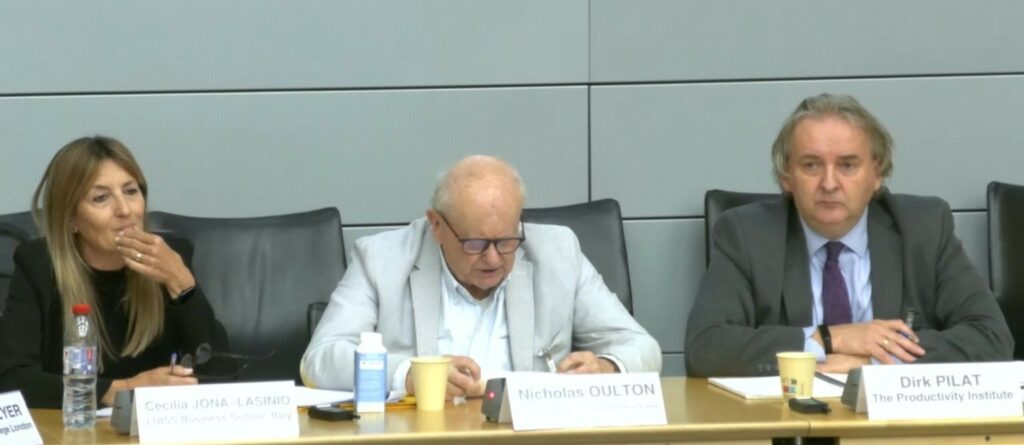

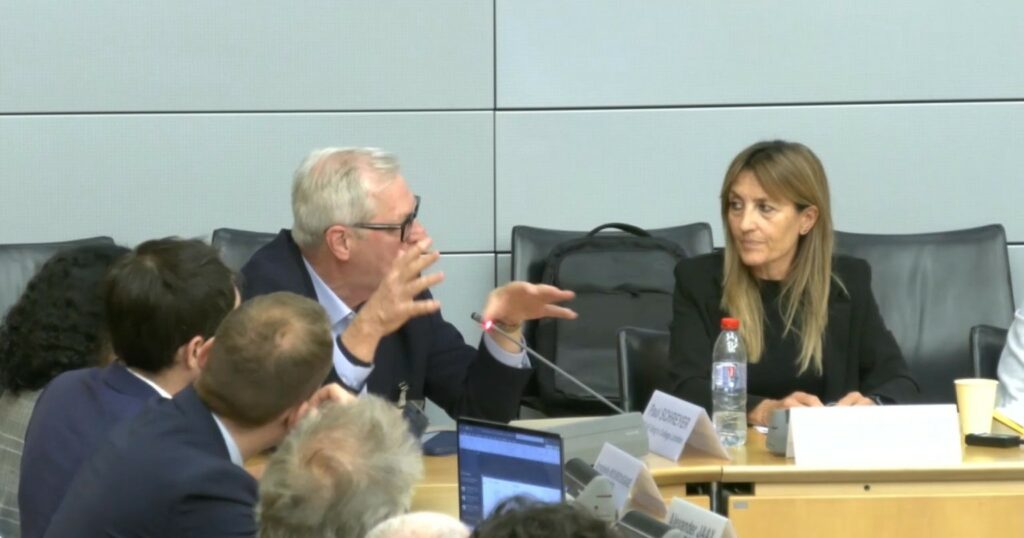

Images: Cecilia Jona-Lasinio, Luiss Business School, Nicholas Oulton, London School of Economics and Political Science (LSE), Paul Schreyer, Economic Statistics Centre of Excellence (ESCoE), Dirk Pilat, The Productivity Institute.